Accurate determination of protein concentration is fundamental to biochemical and molecular biology research. The Bradford assay, first described by Marion M. Bradford, has become one of the most widely used methods due to its speed, sensitivity, and simplicity compared to the Lowry assay. Its reduced susceptibility to interference from many non-protein components further enhances its reliability in routine laboratory applications.
The Bradford method relies on the binding of Coomassie Brilliant Blue G-250 dye to proteins. In acidic conditions, the dye exists in multiple ionic forms (red, green, and blue). Upon protein binding, the dye shifts predominantly to its blue anionic form, which strongly absorbs at 595 nm. The absorbance measured at this wavelength is directly proportional to protein concentration, allowing precise and reproducible quantification.
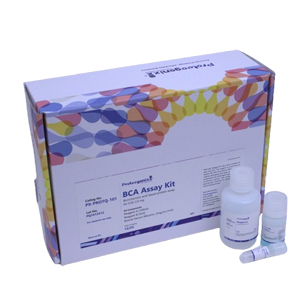
This kit is supplied with following components:
| Component |
Catalog No. |
Storage |
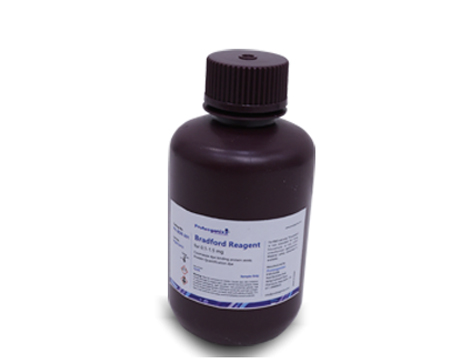
| Bradford Reagent |
PX-BDR-201 |
Room Temperature |
| Protein Standard |
PX-PS-101 |
2-8℃ |
| SPECIFICATION |
| Parameter / Attribute |
Details |
| Assay Type |
Bradford Protein Assay |
| Standard Concentration |
Bovine Serum Albumin (BSA): 2 mg/mL |
| Detection Method |
Colorimetric (Absorbance at 595 nm) |
| Application |
Protein Quantification in Solution |
| Compatible Equipment |
Spectrophotometer, Microplate Reader |
| Kit Contents |
Dye Reagent Concentrate (sufficient for dilutions) BSA Standard (Lyophilized or solution form) |
| Specificity |
General protein detection; not target-specific |
| Sufficient For |
~250 cuvette assays and ~500 cuvette assays |
| Product Format |
Ready-to-use reagent with dilution flexibility |
| Unit Size / Quantity |
500mL and 1 L capacity |
Key Features & Advantages
Fast & Sensitive – Delivers accurate protein measurements within minutes.
Reduced Interference – Less affected by many non-protein components compared to the Lowry assay.
High Specificity – Color shift (to blue form) occurs only upon protein binding, enabling robust quantification.
Compatible with Reducing Agents – Unlike Lowry and BCA assays, effective in the presence of reducing agents.
Cost-Effective & Convenient – Simple, single-step protocol with minimal reagent preparation.